
Every wedding season at our Kondapur atelier, we see the same moment play out: a bride sits down with a Pinterest board full of North Indian maximalism — heavy 3D florals, full-glitter coffins — then unwraps her Kanjivaram and her grandmother’s temple jewellery, and we both realise the board doesn’t match the bride.
South Indian bridal aesthetics are their own language. The silk does the talking, the gold is the statement, and the jasmine is the accessory. Your nails should join that conversation, not shout over it. Here’s how we approach it at the table.
Understanding South Indian Bridal Aesthetics
When a Tamil, Telugu, Kannada, or Malayali bride sits with us, we’re usually designing around:
- Silk sarees — maroon, gold, green, white; the pattern is the embellishment
- Temple jewellery — gold-heavy statement pieces, heavier than most North Indian sets
- Flowers in the hair — jasmine or rose garlands rather than a heavy maang tika
- Simpler, glow-focused makeup — the face isn’t heavily contoured
- Understated luxury — elegance through restraint, not maximal design
The nail brief that flows from this: elegant, minimal, warm, and friendly to yellow gold. It’s the same sensibility behind the quiet-luxury minimalism trend — South Indian brides were doing it long before it had a hashtag.
Designs We Reach for Most Often
Gold + Burgundy (Timeless)
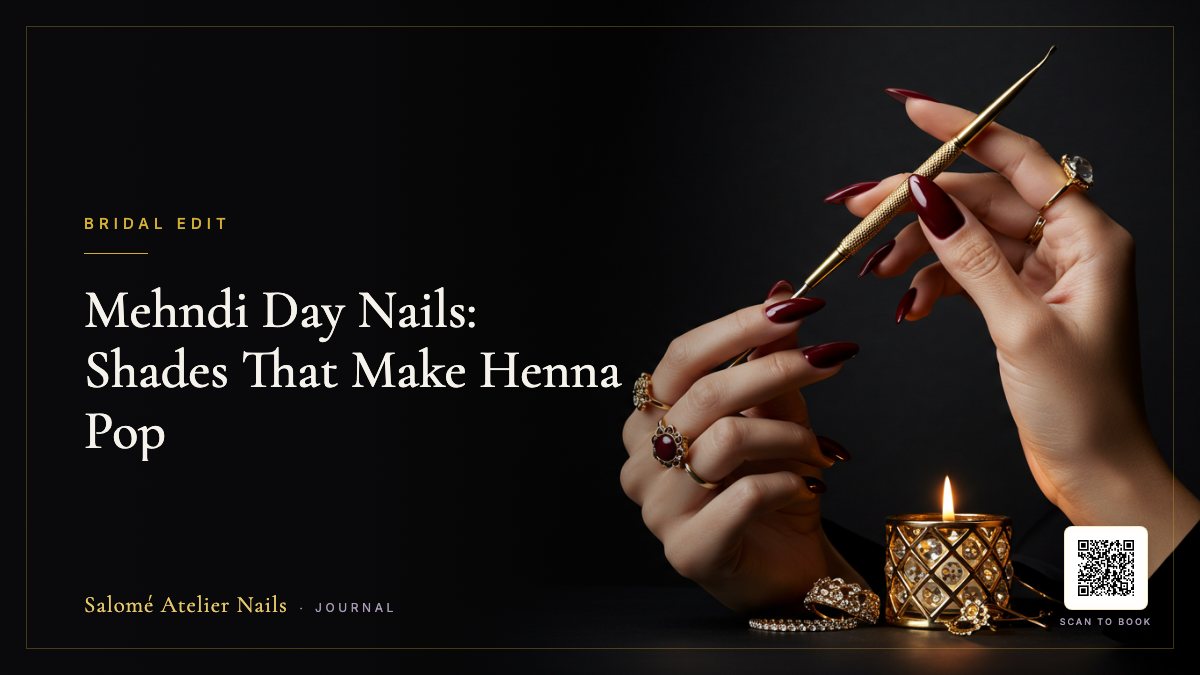
Deep burgundy with fine gold leaf or foil accents. This is the design we end up recommending most, because it matches maroon silk, echoes temple gold, and never competes with the saree. If a bride is undecided at her trial, this is the safe-but-stunning fallback.
Cream + Green (Temple Aesthetic)
Cream or ivory base with a small green leaf or floral detail tucked into one corner — a quiet nod to jasmine and mango-leaf torans. Cream is the most forgiving base we work with; it pairs with every saree colour in the trousseau.
Gold + White (Minimalist)
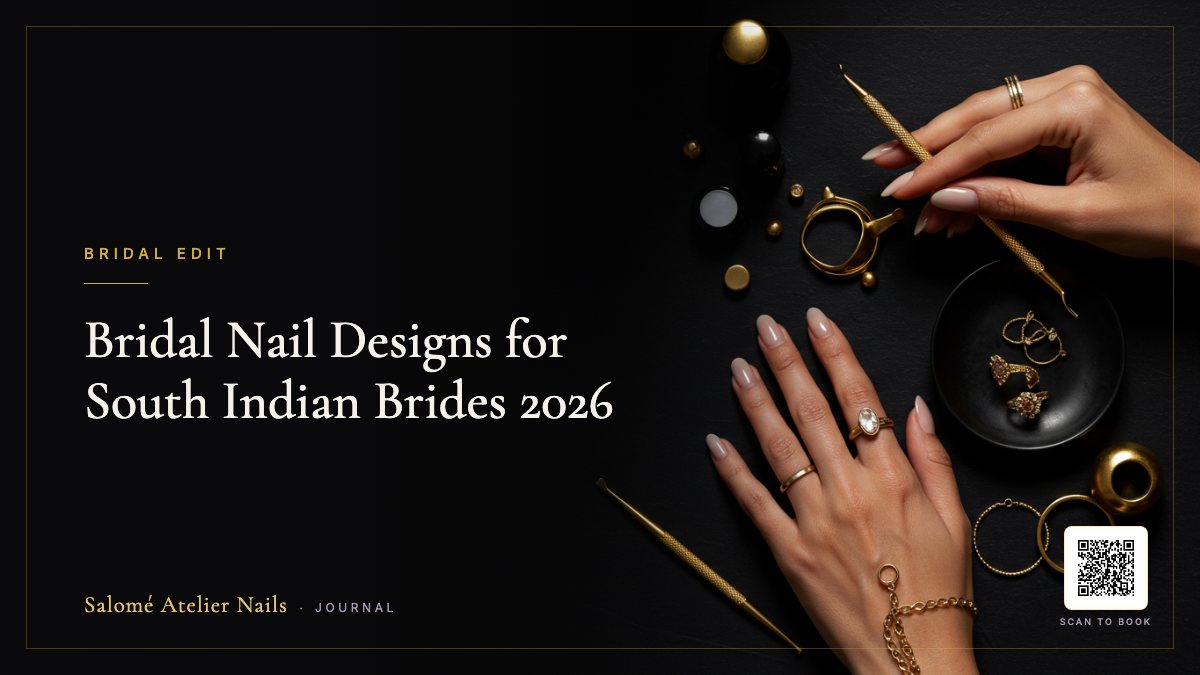
Pearl or white base with fine gold lines. For the bride who wants her hands to read “modern” in photographs while still respecting tradition. The gold linework should be thinner than you think — at arm’s length it should whisper.
Saree Pattern Matching
We study your saree border and recreate one key motif — not the whole pattern — on an accent nail or two. The honest caveat here: this only works when it’s simplified. Brides sometimes ask us to miniaturise an entire zari border across ten nails, and we’ll gently talk you out of it; at nail scale it turns to visual noise. One motif, two nails, maximum.
Planning tip: show us the saree (or clear photos of it) two to three weeks before your trial so there’s time to sketch.
Temple Jewellery Inspired
Geometric patterns, pearl accents, fine filigree details that bridge your vaddanam and your fingertips. Sophisticated, cultural, and one of our favourite briefs to execute.
Colour Pairings by Saree
- Traditional maroon saree: deep burgundy or wine-red nails with minimal gold
- Gold or cream saree: neutral beige with gold accents, or white with gold foil
- White / off-white saree: cream with subtle jewel-tone accents, or pearl finish with gold
- Green or emerald saree: cream base with green foil, or nude with an emerald detail
- Blue or teal saree: navy with gold, or teal with white foil
If your saree is very bright — hot pink, neon orange — go neutral on the nails (cream, soft white) with gold accents. Matching a fluorescent silk shade nail-for-saree almost never photographs well.
Shape and Length: Where We’re Honest With Brides
The shapes we recommend: almond (elegant, traditional), short coffin (modern interpretation), or oval (timeless, works with any saree).
On length, we’re firm: medium, not dramatic. South Indian wedding rituals are hands-on — tying the mangalsutra, applying kumkum, handling the talambralu rice, receiving aashirvadam. Every season we have a bride who wanted extra-long stilettos reconsider after her trial, once she’s mimed the rituals and felt the nails catch. This is exactly the kind of thing a bridal nail trial exists to catch — better three weeks out than on the muhurtham morning.
Planning Timeline
- 8 weeks out: finalise your saree, book a consultation, share reference photos
- 4 weeks out: trial appointment — bring the actual saree and jewellery if you can
- 2 weeks out: adjustments locked in, design finalised
- 2–3 days out: final application, fully cured and set before the first ceremony
Your Nails Across the Ceremonies
One design usually carries you through, but each ceremony tests it differently. At the mehndi, your nails sit under henna paste for hours — some staining at the edges is normal and traditional (we’ve covered colour choices for that day in our mehndi day nails guide). At the haldi, turmeric will find your hands no matter how careful your cousins promise to be; darker, warmer shades shrug it off, pale ones don’t — our haldi-safe nails guide goes deep on which colours survive. By the wedding day itself, if you timed the final application for two to three days before, your nails are fresh, cured, and pristine.
Quick Answers
What are the best South Indian bridal nail designs?
Designs that defer to the silk and the gold: burgundy with gold foil, cream with a small temple-flower accent, or white with fine gold lines. Minimal beats maximal for this aesthetic.
How do I choose traditional bridal nails for an Indian wedding?
Work backwards from your saree colour and your jewellery metal. Warm, gold-friendly tones in an almond or oval shape at medium length suit nearly every South Indian bridal look and survive the rituals.
Should my nails match my lehenga or saree exactly?
No — complement, don’t copy. A nail shade that echoes one tone in the saree (or simply pairs with your gold) looks intentional; an exact match tends to flatten in photos.
What nails go with temple jewellery?
Anything warm and gold-leaning: burgundy with gold accents, cream with filigree-style linework, or pearl finishes. Cool silvery tones fight with temple gold.
—
Plan your South Indian bridal nails with us at Salomé Atelier Nails in Kondapur. We design around your saree, your jewellery, and your rituals — not against them. Schedule your bridal consultation.
—
Last updated: 2026-05-06 · Hyderabad, India