

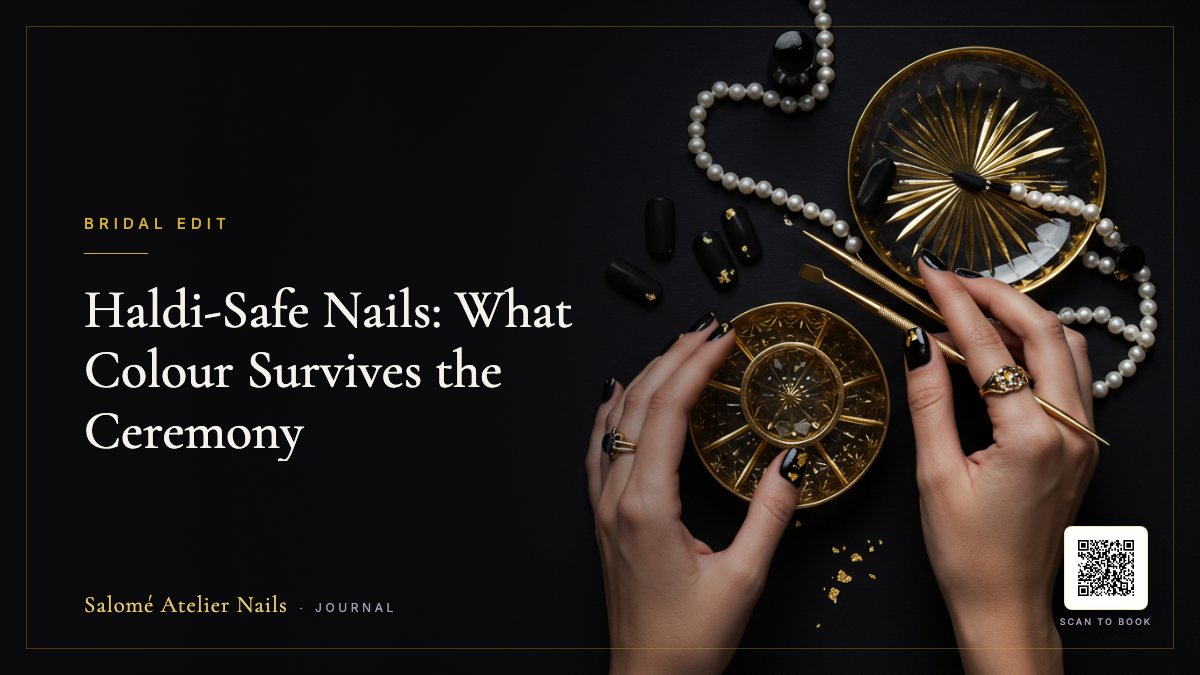
If there’s one ceremony that humbles a fresh manicure, it’s the haldi. Every wedding season at our Kondapur atelier, a bride shows us her hands after the turmeric ceremony — and whether she’s laughing or wincing depends almost entirely on one decision she made days earlier: the colour.
Turmeric is a natural dye, and it does not negotiate. Pale nails come out of a haldi tinged yellow-orange; the right warm, dark shades come out looking like nothing happened. Here’s the colour logic we walk every haldi-bound bride through.
The Haldi Nail Challenge
Your hands will be covered in turmeric paste — that’s the whole point of the ceremony, and no amount of careful aunties changes it. So the goal isn’t avoiding turmeric. It’s choosing a nail colour that either:
1. Won’t show the staining (dark and warm enough that a yellow cast disappears into it), or
2. Actually looks better with it (warm tones the turmeric simply deepens)
Colours That Survive the Haldi
These come out of the ceremony looking untouched:
- Deep burgundy or wine red — turmeric staining is invisible against it; also the most universally bridal shade on this list
- Deep gold or bronze — turmeric’s yellow blends straight into the colour
- Chocolate or warm brown — brown swallows yellow staining entirely
- Burnt orange or terracotta — staining is indistinguishable from the shade itself
- Deep teal, dark emerald, navy — dark cool-but-saturated shades hide yellow well
Colours that improve with a little turmeric
- Warm nude or beige — a light turmeric kiss warms the tone, often flatteringly
- Peachy or warm pink — staining reads as added depth rather than damage
Colours to avoid
This is the honest list, learned from many post-haldi hands:
- White or cream — staining looks like a bright yellow mistake, not a tradition
- Pale pink / ballet pink — obvious, unflattering staining
- Pale yellow — turns muddy
- Icy silver or cool whites — yellow cast shows immediately
- Very pale nudes — too little pigment to hide anything
If your heart is set on a pale wedding-day look, that’s fine — it just means your haldi and wedding nails shouldn’t be the same set (more on sequencing below).
Finishes Matter Too
- Glossy, high-shine: the best haldi finish — reflection disguises discolouration
- Metallic and shimmer: sparkle distracts the eye from any cast
- Chrome and mirror finishes: excellent — the reflective surface hides staining almost completely, and warm chromes are gorgeous on Indian skin tones (we’ve mapped which chrome shades suit which undertones)
- Matte: the weakest choice — flat surfaces show staining most
Quick Recommendations by Skin Tone
- Fair/medium: deep burgundy or warm gold first; peachy nude or burnt orange second
- Medium-deep: deep gold or bronze first; burgundy or burnt orange second
- Deep: deep gold or bronze first; rich chocolate or deep emerald second
Minimising the Staining
Even with the right colour, a few habits help:
1. A thick protective top coat before the ceremony adds a barrier layer
2. Rinse soon after — don’t let the paste sit on your nails for hours
3. Cuticle oil after washing — it lifts residue and rehydrates skin the turmeric dried out
4. Some brides wear sheer gloves for part of the ceremony — though in our experience the turmeric usually wins anyway, which is why colour choice beats protection every time
The fade timeline: staining is brightest in the first few hours, softens with the first wash, and on a gel surface largely fades over the next two to three days — usually gone by the wedding if you chose a dark shade.
Haldi Nails vs. Wedding Nails: The Sequencing Question
This is the conversation we have at nearly every bridal trial, because Hyderabad weddings stack the ceremonies tightly:
Option 1 — one set carries everything. A haldi-safe shade (burgundy, deep gold, bronze) that’s also wedding-appropriate. One appointment, no mid-week logistics. This is what most of our brides choose, and shades like burgundy-with-gold conveniently sit at the heart of South Indian bridal design language anyway.
Option 2 — separate haldi and wedding sets. A haldi-safe set early in the week, removed and replaced with fresh wedding nails two to three days before the ceremony. More flexibility (this is how you get pale or white wedding nails safely), but it means budgeting a second full appointment into an already packed week. The same logic applies if your mehndi nails are a different design.
The honest trade-off: Option 1 is calmer; Option 2 is prettier if your dream wedding shade is pale. There’s no third option where white nails survive a haldi.
Quick Answers
What are the best haldi nails in India?
Dark, warm, glossy shades: deep burgundy, gold, bronze, chocolate, or terracotta. Turmeric staining disappears into all of them.
Is there a turmeric-resistant nail polish?
No polish is truly turmeric-proof — turmeric is a dye. But dark pigments and high-shine or chrome finishes hide the cast so well it’s effectively invisible.
What should haldi ceremony nails avoid?
White, cream, pale pinks, icy tones, and matte finishes. Pale matte nails show every trace of yellow staining.
Which nail colours for haldi also work for the wedding day?
Deep burgundy with gold accents, warm gold, or bronze — all haldi-proof and fully bridal, which is why most of our brides carry one such set through every ceremony.
—
Get haldi-safe nails at our Kondapur atelier — we’ll recommend a shade and finish that comes out of the turmeric looking untouched. Book your haldi nail consultation.
—
Last updated: 2026-05-06 · Hyderabad, India